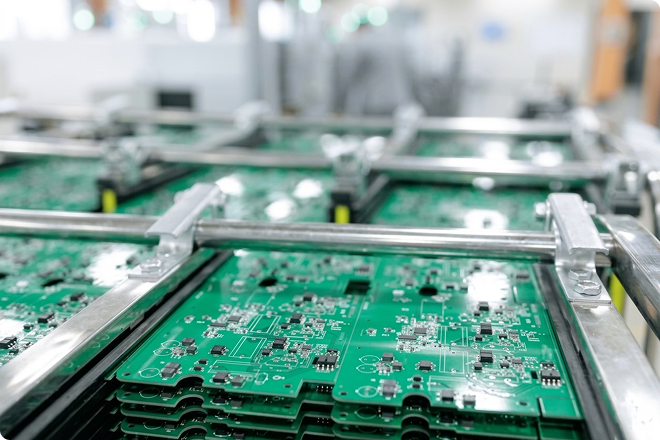
Our production services make it easy to move from a validated prototype to full-scale manufacturing, supporting everything from short runs (1–500 boards) to medium volumes (500–5,000) and high-volume production (5,000+).
We provide turnkey, consigned (kitted), and partially consigned services to support all your manufacturing needs.
Our process is designed for efficiency and repeatability, allowing printed circuit boards to be produced in large volumes while maintaining strict quality and performance standards.
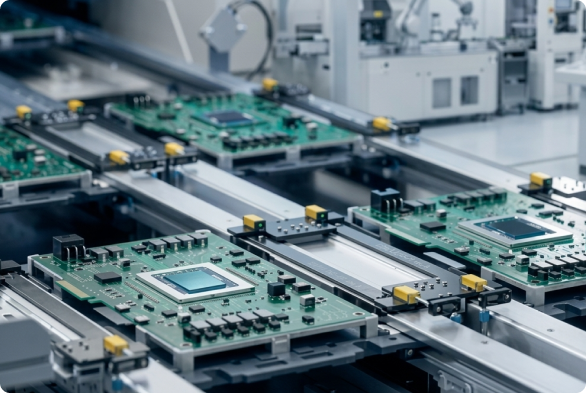
We use automated assembly equipment and perform detailed quality inspections to ensure every board is built correctly and reliably.
Production PCB Assembly Capabilities
Build Quantities
Supports medium- to high-volume production, from hundreds to thousands of assembled printed circuit boards.
Repeatable Production Processes
Our proven manufacturing procedures maintain repeatable quality across every production run.
PCB Types Supported
Rigid, flexible, rigid-flex, and metal-core printed circuit boards.
Technology And Components
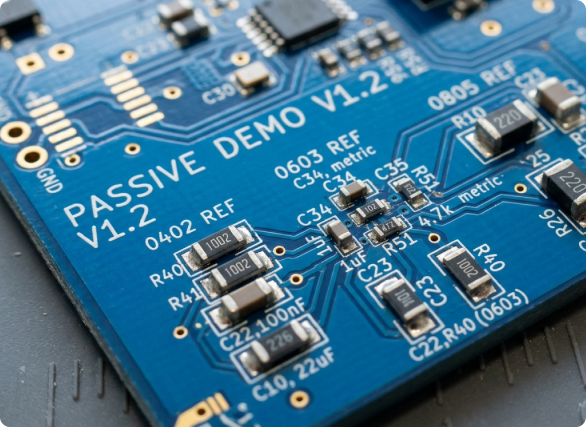
Surface Mount Technology (SMT), Through-Hole (THT), and mixed-technology assemblies including BGAs, QFNs, fine-pitch components, leadless packages, and passive components as small as 0201.
SMT Assembly Method
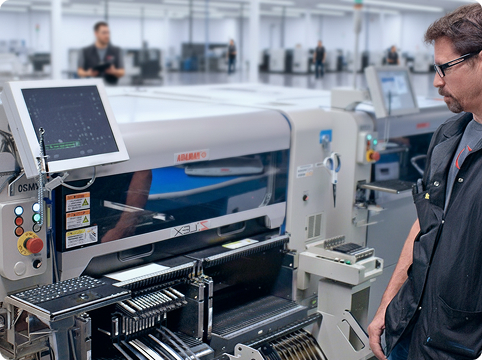
We use high-speed Yamaha pick-and-place machines to ensure accurate and reliable component placement.
Through-Hole Soldering
Through-hole components are soldered using wave or selective soldering equipment.
Panelized Board Processing
Panelized boards are preferred to increase production efficiency.
Inspection
Every production batch undergoes visual inspection and automated optical inspection (AOI). X-ray inspection is used for BGAs, QFNs, and other leadless devices.
Traceability
Production assembly support component tracking, and process documentation.
Electrical Testing (Optional)
Detects opens, shorts, incorrect component values, and missing components.
Functional Testing (Optional)
Verifies that the finished boards perform according to their design specifications.
We use Yamaha pick-and-place machines in our production SMT assembly lines because they provide the speed and accuracy needed for repeatable, high-quality results on every build.
High Placement Accuracy & Vision Alignment
Advanced vision systems verify component orientation and support precise placement.
High-speed Production
Fast placement supports efficient medium-to-high volume production.
Wide Component Range
Places components from small 0201 passives to larger integrated circuits and connectors.
Consistent Assembly Quality
Automated placement helps maintain consistent quality across a wide range of printed circuit board designs.
Production PCB Assembly: Do’s And Don’ts
Do’s
Provide complete and updated documentation to prevent errors and delays
Include Gerber files, drill files, BOM, pick-and-place files, and assembly drawings. Make sure that all files are complete and updated. Make sure all files match the same revision level before sending a build to production.
Clearly mark all DNP (Do Not Populate) components.
Mark any parts that require special handling.
Provide notes for special build requirements.
Mark polarity for all polarized components (diodes, capacitors, LEDs, and ICs) in assembly drawings and silkscreen to prevent incorrect placement.
Confirm component availability
Verify that all components are available in sufficient quantities before releasing a production order.
Follow design for manufacturability (DFM) guidelines. Production boards should be designed to support automated manufacturing processes. Recommended practices include:
Using standard footprints
Providing fiducials for automated placement
Leaving enough space between components
Designing footprints compatible with automated soldering processes
Use commonly available components when possible
Using standard components when possible simplifies procurement and streamline the manufacturing process.
Design for testing.
Include test points to allow in-circuit and functional testing.
Don’ts
Avoid using prototype documentation for production
Use approved production documentation.
Don’t use obsolete or hard-to-source components
Avoid using hard-to-find or obsolete parts.
Verify availability before finalizing the design.
Update files after design changes
Make sure documentation reflects the latest design revision.
Validate Production before full release
Prototype approval does not replace the need for inspection and testing during production.
Component Supply Options
We Offer Flexible Component Sourcing Options To Support Production Manufacturing.
Turnkey Manufacturing
We procure all required components and manage the entire build process.
Consigned (Kitted) Production
Customers supply all components required for the build.
Partial Consignment
Customers provide selected components while we source the remaining parts.
For consigned builds, components should be supplied in proper packaging such as full reels, trays, or tubes to support automated production equipment.
Consigned (Kitted) Assembly Best Practices For Production Builds
When supplying components for production PCB assembly, it is important to provide quantities above the exact build requirement. This helps ensure a smooth production process, minimizes delays, and accounts for normal manufacturing loss.
Recommended Component Overages:
Passive components (0402, 0603, 0805): +10–20% extra, or a minimum of 20–30 pieces
ICs in tape/reel packaging: +2–3 additional pieces
QFNs, BGAs, fine-pitch ICs: +2–5 extra pieces, depending on complexity and packaging
Connectors or mechanical components: +1–2 additional units
High-value or limited-availability components: Provide at least one spare, or more if rework risk is a concern
For production builds, providing properly packaged components (preferably full reels) is strongly recommended to support efficient automated assembly. All materials should be clearly labeled, organized, and verified for correct orientation and polarity. Any approved substitutions should be documented before release to production.
Production PCB Assembly, Frequently Asked Questions
FAQs
General Questions
Production PCB assembly is the process of building printed circuit boards in larger quantities using automated methods after the design has been validated through prototypes.
Short run: ~1 to 500 boards Medium Volume Production: ~500 to 5,000 High Volume Production: 5,000 to 10,000+
Lead time depends on the complexity of the board, the availability of components, and the order quantity. Production builds typically take several weeks.
Design And Documentation
Required documentation typically includes:
Gerber files
Bill of Materials (BOM)
Pick-and-place file also known as centroid file or XY data
Assembly drawings
Test procedures if electrical or functional testing is required
Yes, we perform design for manufacturability (DFM) and design for assembly (DFA) reviews to identify potential issues before production begins.
Components
Yes, we offer both full and partial component sourcing.
We may suggest alternative part numbers and wait for customer approval before proceeding.
Assembly Process
Yes. Automated pick-and-place machines and wave or selective soldering machines are used to maintain consistent quality and efficient production.
Yes, inspection methods include:
Visual inspection
Automated Optical Inspection (AOI)
X-ray inspection for BGAs and leadless devices
Testing And Quality
Yes, we offer electrical and functional testing, including in-circuit testing (ICT), when appropriate test procedures or fixtures are available. Additional charges may apply.
Defects are corrected through rework, and boards are re-inspected to verify quality.
Ordering and Manufacturing
Yes, after validation, prototypes can be moved into production.
Yes, we protect customer intellectual property and offer NDA agreements when required.
Common causes may include:
Component shortages
Incomplete documentation
Design changes after production begins
Supply issues
Custom Quote
For a custom quote, please email your Gerber files and BOM to support@pcbassemblyexpress.com and include your required quantities and lead times. You may also visit our Custom Quote page.