
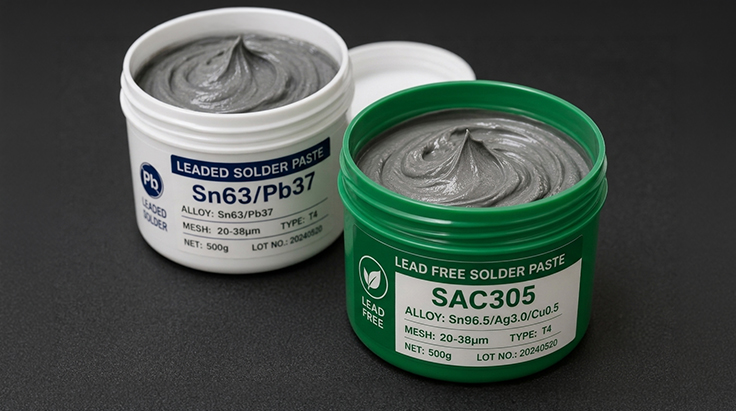
Solder Paste in the PCB Assembly Process
What Is Solder Paste?
Solder paste is a mixture of microscopic solder alloy particles and flux used in the PCB assembly process. It is applied to printed circuit board pads before component placement and plays a critical role in forming reliable electrical and mechanical connections during soldering.
How Is Solder Paste Used?
During SMT assembly, solder paste is printed onto the printed circuit board pads through a solder stencil. SMT components are then placed into the paste using a pick-and-place machine, and the assembly passes through a reflow oven. As the temperature rises, the solder particles melt and form solder joints, while the flux removes oxidation, cleans the metal surfaces, and helps the solder flow properly.
Properties of Solder Paste
Particle Size: Diameter of the solder alloy particles in the paste, which affects print quality and how well it works with very small components.
Metal Content: Percentage of solder metal contained in the paste, which affects solder volume and joint formation.
Viscosity: Measures how easily the solder paste flows during printing while still maintaining its shape on the PCB pads.
Paste Release: Measures how well solder paste transfers from the stencil apertures onto the PCB pads during printing. Poor paste release leads to insufficient solder volume and weak solder joints.
Slump Resistance: The ability of the solder paste to keep its shape after printing without spreading too much, helping prevent solder bridging between adjacent PCB pads.
Tackiness (Tack): It refers to the temporary stickiness of solder paste that holds SMT components in place on the printed circuit boards before reflow soldering, helping prevent components from shifting during assembly.
Wetting Performance: It indicates how well the melted solder spreads across pads and component leads during soldering.
Flux Activity: Ability of the flux to remove oxidation from metal surfaces and improve wedding.
Stencil Life: How long solder paste can remain on the stencil during production before exposure to air and room temperature begins to affect print quality.
Shelf Life: How long solder paste remains usable when stored properly. Most pastes have a refrigerated shelf life of about six months.
Tip: Self-Alignment
When solder paste melts during reflow, the surface tension of the molten solder naturally pulls slightly misaligned components into the correct position on the printed circuit board.
Importance of Solder Paste in PCB Assembly
Choosing the right solder paste and applying it correctly are important steps in the PCB assembly process. They help determine how well the components line up, how strong the solder joints are, and how reliable the finished board will be.
Good paste selection and printing affect:
- Solder joint quality
- Component alignment
- Electrical reliability
- Thermal performance
- Manufacturing yield
Poor solder paste selection or printing quality can result in defects such as:
- Solder bridging
- Tombstoning
- Voiding
- Insufficient solder joints
- Component misalignment
- Solder skipping
- Solder balling
Types of Solder Paste Alloys
Solder paste is available in two main types: lead-free and leaded. The choice depends on the application, regulatory requirements, and performance needs.
Lead-Free Solder Paste
Lead-free solder paste is the most common type used today because it complies with RoHS environmental regulations that restrict the use of lead in electronic products. It contains solder alloy particles and flux, just like leaded paste, but uses lead-free alloys such as SAC305 (96.5% tin, 3.0% silver, and 0.5% copper).
Benefits:
- RoHS compliant
- Good mechanical reliability
- Widely used in commercial electronics
Leaded Solder Paste
Leaded solder paste is commonly used in legacy, military, and aerospace electronics. Sn63/Pb37 is the most widely used leaded alloy.
Benefits:
- Lower reflow temperature
- Excellent wetting characteristics
- Reduced risk of some soldering defects
Solder Paste Type
Solder paste is classified by the size of its solder particles. Smaller particles allow more accurate printing and work better with very small component pads and fine-pitch designs.
| Type | Typical Application |
| Type 3 | Standard SMT assembly |
| Type 4 | Fine-pitch components |
| Type 5 | Ultra-fine pitch components |
Flux Types
No-Clean Flux
Widely used in commercial PCB assembly, this flux produces very low post-soldering residue, eliminating the need for cleaning in most assembled PCB applications.
Water-Soluble Flux
Provides excellent cleaning and soldering performance but requires the assembled printed circuit boards to be washed after reflowing to remove flux residues.
Rosin-Based Flux
A traditional flux type used in certain military, aerospace, and other specialized electronic applications.
Solder Paste and Stencil Design The stencil design and solder paste selection must work together to achieve consistent paste deposition and reliable solder joints. The stencil controls the amount and shape of the paste printed onto each PCB pad, while the paste properties determine how the paste prints, releases from the stencil, and behaves during reflow. The right combination of stencil design and solder paste helps reduce soldering defects such as bridging, tombstoning, voiding, and insufficient solder can be greatly reduced.
How Solder Paste Properties Affect Assembly Defects
The right paste properties can help prevent common soldering defects.
Defect | Recommended Solder Paste Characteristics |
| Solder Bridging | Type 4/5 (small particle size), good shape retention (high slump resistance), consistent flow (controlled viscosity) |
| Tombstoning | Uniform solder volume (Consistent metal content), balanced solder flow (controlled wetting), consistent flux activity |
| Voiding | Low-voiding flux and controlled gas release |
| Insufficient Solder | Good paste release, sufficient solder volume (metal content), controlled viscosity |
| Solder Skipping | Good solder flow (reliable wetting), active flux, consistent printing |
| Component Misalignment | Good component holding force (consistent tackiness), uniform paste deposits, stable reflow behavior (controlled solder wetting) |
Solder Paste Storage and Handling
To achieve the best results, solder paste should be stored and handled properly. Improper storage and handling can affect print quality and solder joint reliability.
- Store at the recommended refrigerated temperature.
- Bring the paste to room temperature before use.
- Stir the paste gently to ensure a consistent texture before printing.
- Use the paste before its expiration date.
Solder Paste Inspection
After printing, the printed circuit board is inspected to ensure the correct amount of paste is placed in the proper location. Inspection may be performed using solder paste inspection systems, automated optical inspection (AOI) systems, or visual inspection to verify paste volume, alignment, height, and print quality.
Conclusion
Solder paste is a critical component in the PCB assembly process because it directly affects solder joint quality, manufacturing yield, and overall product reliability. Proper solder paste selection, stencil design, printing, storage, and handling are essential for producing high-quality PCB assemblies while minimizing soldering defects and rework.
LEAVE A REPLY